AI+ Healthcare Administrator™

# AP-4801

Transform Healthcare Management with Intelligent Administration
  • Operational Excellence: Learn how AI streamlines billing, scheduling, claims, and staff workflows to relieve administrative burden.
  • Resource Optimization: Master predictive analytics, demand forecasting, and data-driven decision-making for efficient hospital operations.
  • Compliance & Privacy: Understand regulatory frameworks, data security, and ethical standards essential for AI-powered administration.
  • Leadership Impact: Equip yourself to lead organizational change — from digital record-keeping to optimized patient flow and cost control.

$195.00

High-Quality Video, E-book & Audiobook
Modules Quizzes
AI Mentor
Access for Tablet & Phone
Online Proctored Exam with One Free Retake
Hands-on Practices

Prerequisites

  • Basic Understanding of Healthcare Systems: Familiarity with healthcare operations and structures.
  • Fundamental Knowledge of AI Concepts: Understanding machine learning and AI fundamentals.
  • Data Privacy and Security Awareness: Knowledge of HIPAA and data protection laws.
  • Project Management Skills: Ability to manage healthcare AI implementation projects.
  • Familiarity with Healthcare Software: Experience with electronic health records (EHR) and healthcare platforms.

Exam Details

Exam Blueprint

ModulesPercentage
Fundamentals of AI for Healthcare Administrators5
Data Literacy for Healthcare Admins11
AI in Operations Optimization12
NLP and Generative AI in Admin Work12
AI in Billing, Coding & Claims12
Ethics, Bias & Regulation in Admin AI 12
Evaluating and Procuring AI Tools12
Telehealth, Virtual Care and Cybersecurity in the Age of AI 12
Becoming an AI Champion in Admin Settings12

Self Study Materials Included

Videos
Engaging visual content to enhance understanding and learning experience.
Podcasts
Insightful audio sessions featuring expert discussions and real-world cases.
E-Books
Comprehensive digital guides offering in-depth knowledge and learning support.
Audiobooks
Listen and learn anytime with convenient audio-based knowledge sharing.
Module Wise Quizzes
Interactive assessments to reinforce learning and test conceptual clarity.
Additional Resources
Supplementary references and list of tools to deepen knowledge and practical application.
Hands-on
Practical experience through real-world exercises, case studies, and applied learning.

Tools You'll Master

TensorFlow
Keras
Apache Spark
Hadoop
Power BI
Python
Tableau
Matplotlib
SQL
Electronic Health Record (EHR) Management Tools
Healthcare Workflow Automation Platforms

What Will You Learn?

Integrating AI Solutions in Healthcare Operations:
Learn to implement AI tools to streamline processes like scheduling, billing, and case management.
Leveraging Predictive Analytics for Healthcare Efficiency:
Apply predictive analytics to optimize resource allocation, forecast patient flow, and enhance decision-making.
Ensuring Compliance and Data Security with AI:
Use AI to ensure HIPAA compliance and safeguard data privacy across healthcare operations.
Managing AI-Driven Healthcare Workflows
Master AI-driven workflow management to automate tasks, reduce costs, and improve service delivery.
Optimizing Healthcare Systems with AI Tools:
Utilize AI for EHR management, real-time reporting, and performance monitoring to enhance patient care and operations.

Certification Modules

Module 1: Fundamentals of AI for Healthcare Administrators
  1. 1.1 Understanding of AI
  2. 1.2 AI in Healthcare Operations
  3. 1.3 Case Study
  4. 1.4 Hands-On: No-Code AI-Based Chest X-ray Classification for COVID-19 and Lung Conditions Using Google Teachable Machine
Module 2: Data Literacy for Healthcare Admins
  1. 2.1 Understanding Healthcare Data Types
  2. 2.2 Using Data for Decisions
  3. 2.3 Case Study 1: Apollo Hospital’s AI-Based Discharge Management System
  4. 2.4 Case Study 2: Cleveland Clinic’s AI Integration for Medical Billing Optimization
  5. 2.5 Hands-On: No-Code Exploration of a Hospital Analytics Dashboard Using Vizly.ai
Module 3: AI in Operations Optimization
  1. 3.1 Streamlining Patient Flow and Resource Optimization
  2. 3.2 Inventory, Maintenance, and Procurement
  3. 3.3 Case Study 1: AI-Powered Emergency Interhospital Transfers
  4. 3.4 Case Study 2: AI for Inventory Waste Reduction in Hospital Supply Chains (Mayo Clinic, Cleveland Clinic & Rush University)
  5. 3.5 Hands-On: AI-Driven Hospital Operations Optimization: A No-Code Predictive Interface Using Julius AI
Module 4: NLP and Generative AI in Admin Work
  1. 4.1 Foundations of NLP and Chatbots
  2. 4.2 Writing and Communication Tasks with Generative AI
  3. 4.3 Case Study: Alleviating Physician Burnout via Clinical Documentation Assistance
  4. 4.4 Hands-On: Meeting Summarization Assistant for Healthcare Admin
Module 5: AI in Billing, Coding & Claims
  1. 5.1 AI in Medical Coding and Documentation
  2. 5.2 Claims Management and Fraud Detection
  3. 5.3 Hands-On: No-Code AI-Powered Medical Claims Denial Prediction
Module 6: Ethics, Bias & Regulation in Admin AI
  1. 6.1 Identifying Bias in Administrative AI Tools
  2. 6.2 Legal & Compliance Considerations
  3. 6.3 Case Study: AI Triage Failure and Legal Exposure at North Bridge Hospital
  4. 6.4: Hands-On: Analyzing Hospital Admission Bias with Claude AI
Module 7: Evaluating and Procuring AI Tools
  1. 7.1 Assessing AI Tools for Quality and Relevance
  2. 7.2 Implementation Planning and Procurement
  3. 7.3 Case Study 1: AI-Powered Cancer Detection at Tata Memorial Hospital
  4. 7.4 Case Study 2: AI-Powered Eye Screening by Forus Health and Microsoft
  5. 7.5 Hands-On: Healthcare Data Visualization with No-Code BI Tools
Module 8: Telehealth, Virtual Care, and Cybersecurity in the Age of AI
  1. 8.1 Understanding Cyber Threats in AI-Driven Healthcare
  2. 8.2 Building a Secure AI-Operations Environment
  3. 8.3 Case Study 1: WannaCry Attack on NHS (2017)
  4. 8.4 Case Study 2: Universal Health Services Ransomware Attack (2020)
  5. 8.5 Hands-On: AI Cybersecurity Risk Dashboard Implementation Using Google Looker Studio
Module 9: Becoming an AI Champion in Admin Settings
  1. 9.1 Introduction: Why This Module Matters Now
  2. 9.2 Leading Small-Scale AI Pilots
  3. 9.3 Identifying Pilot Opportunities in Departments
  4. 9.4 Stakeholder Alignment: IT, Compliance, Frontline Staff
  5. 9.5 Building Organizational Readiness
  6. 9.6 Step-by-Step Guide: No-Code AI for Medical Claim Denial Prediction Using Relevance AI

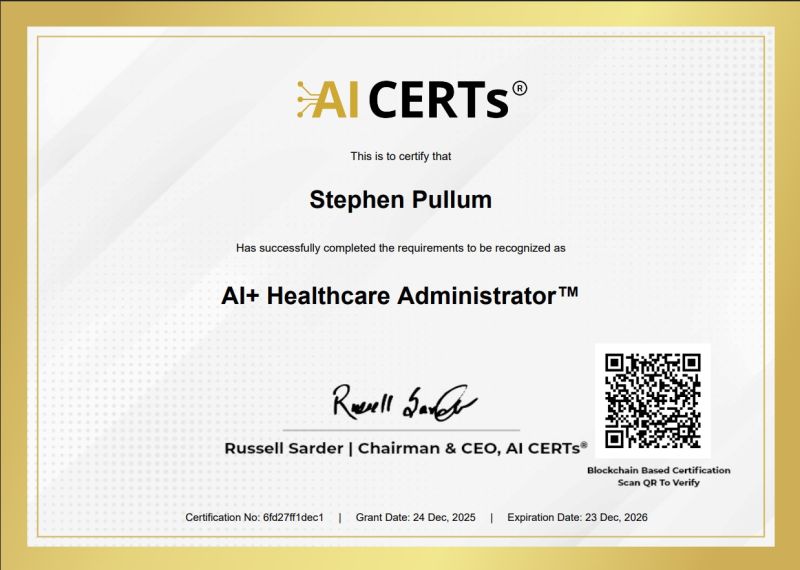
Earn a Shareable Certification Credential

Add to LinkedIn under "Licenses & Certifications"

Showcase your expertise to potential employers and professional connections.

Download a Verified Certificate - Blockchain

Your certificate is secured on the blockchain for tamper-proof authenticity and can be downloaded as a high-quality PDF for personal records or professional sharing.

Share on social media

Celebrate your accomplishment with your network on all social platforms.

Industry Opportunities after Certification Completion

Median Salaries
Unknown
With AI+ Healthcare Administrator™
Unknown
% Difference
Unknown

Trusted Reviews by Our Learners

Recommended Certifications

Learner Success Stories

Frequently Asked Questions

Yes, you’ll gain hands-on experience with AI tools for healthcare operations, resource management, and patient coordination, allowing you to apply these skills immediately in real-world healthcare settings.
This course integrates AI with healthcare workflows, focusing on predictive analytics, automation, and smart resource management to optimize hospital operations, reduce costs, and improve patient care.
You’ll work on projects such as AI-driven patient scheduling, healthcare resource optimization, compliance monitoring, and a healthcare administration capstone project.
The course combines theoretical knowledge with practical applications, case studies, and hands-on projects to help you apply AI tools to improve operational efficiency and patient outcomes in healthcare settings.
You’ll develop AI skills specific to healthcare administration, preparing you for roles in healthcare management, operations optimization, and AI-powered healthcare administration across hospitals, clinics, and healthcare facilities.
Share